Facebook Ads Not Getting Leads? Here's Why.
If you've increased your budget and you're still not getting leads, the problem almost certainly isn't your budget. It's your ad!

If you've increased your Facebook ad budget and you're still not getting leads, the problem almost certainly isn't your budget.
It's your ad.
More specifically, it's that your ad is talking at people instead of connecting with what they actually care about. That's not a guess — it's the single most common pattern we see when we run a 100-point psychological audit on local service business ads.
The budget trap
Here's the instinct most business owners follow: ad isn't working → spend more → still isn't working → spend even more.
It feels logical. It's also usually wrong.
Facebook's algorithm is good at one thing above all else: finding people who are likely to engage with what you're showing them. If your ad isn't converting at a small budget, a bigger budget just shows the same unconvincing ad to more people, faster. You don't fix a leaky bucket by pouring in more water.
A real example
We recently audited an ad for a plumbing tools product — a drill attachment for clearing clogged drains. The headline was clear, the product photo was decent, the offer was reasonable. On paper, nothing was obviously "broken."
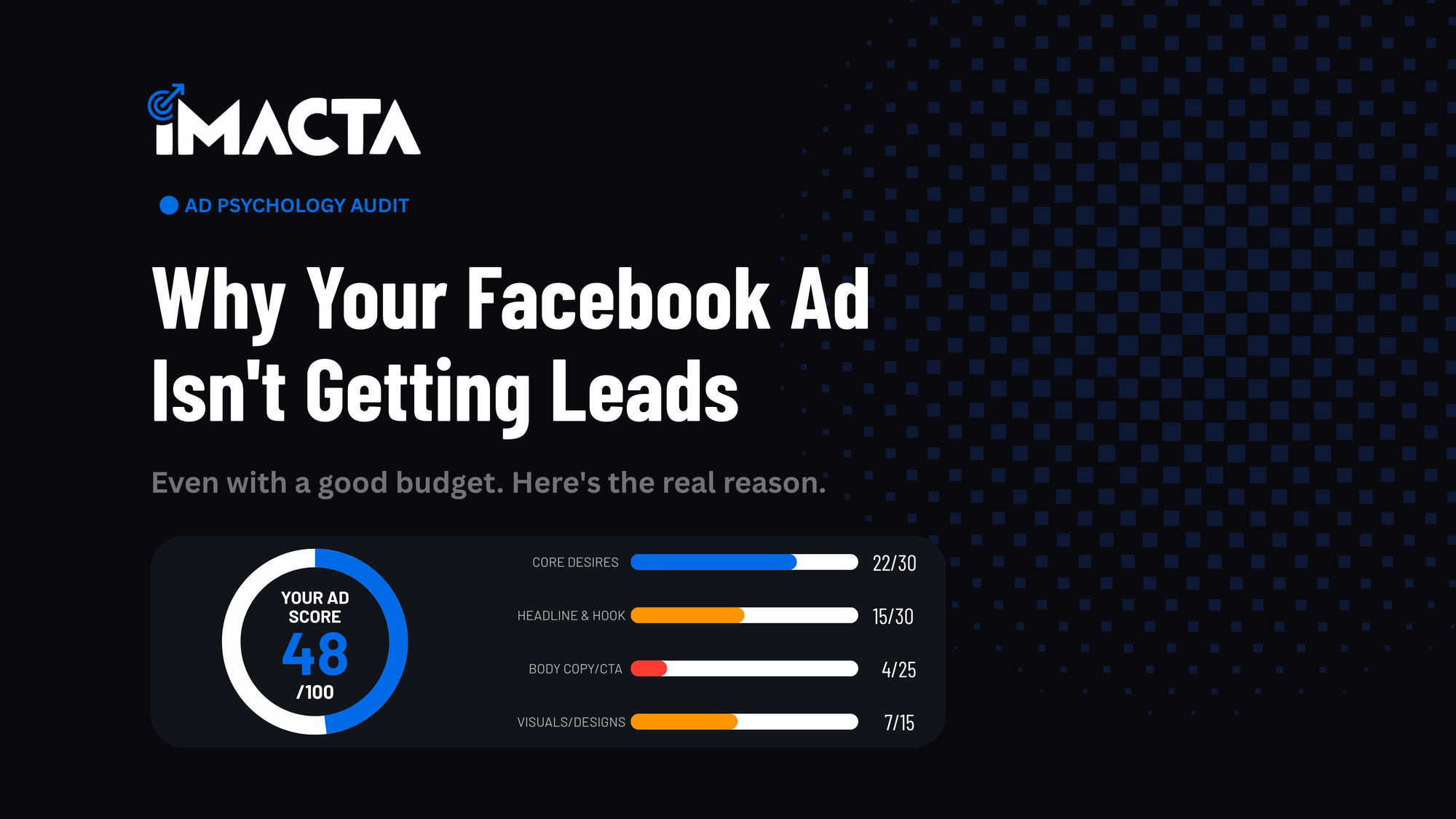
It scored 48 out of 100.
Here's why. The ad's body copy read like a spec sheet:
"Turn your drill into a professional drain cleaning machine and clean the entire pipe, not just the blockage. Built for real jobs where others fail."
Functionally accurate. Emotionally flat. It tells the reader what the product does — but it never makes them feel the gap between their current frustration (another weekend, another clogged drain, another $400 plumber bill) and the relief of having it actually fixed.
The breakdown, phase by phase:
- Core desires: 22/30 — the ad identifies the right audience but never dramatizes their pain
- Headline & hook: 15/30 — generic benefit language, no curiosity gap to stop the scroll
- Body copy & CTA: 4/25 — this is where it really fell apart
- Visual & design: 7/15 — text-only, no formatting to guide the eye to a CTA
That body copy score is the real story. Zero authority signals. Zero risk reversal. Zero urgency. No explicit call to action — the reader has to guess what to do next. For a $50–$500 considered purchase, that leaves all the perceived risk sitting with the buyer. Most people won't take on that risk alone. They'll keep scrolling.
None of that is a budget problem. You could 10x the spend behind that ad and it would still ask the reader to do all the emotional and logical work themselves.
What this looks like for a service business
Swap "drain cleaning drill attachment" for "emergency HVAC repair" or "24/7 electrician" and the same pattern shows up constantly:
- A headline that states a feature ("Licensed & Insured Electricians") instead of a felt outcome ("Stop worrying about that flickering light turning into a fire risk")
- Body copy with no urgency — nothing that explains why someone should call today instead of bookmarking it for "later" (which means never)
- No risk reversal — no guarantee, no "if we're late, the visit's free," nothing that lowers the cost of saying yes
- A CTA that's easy to miss, or worse, not there at all
Individually, each of these feels small. Together, they're the difference between an ad that gets ignored and one that gets clicked.
How to check your own ad
Before spending more, pull up your current ad and ask three questions:
- Does the headline make someone feel something, or just describe something? "24-hour emergency plumbing" describes. "Don't spend tonight Googling 'water shutoff valve location' at 2am" makes someone feel understood.
- Is there a reason to act now? Not fake scarcity — a real, honest reason. A same-day guarantee, a seasonal deadline, a genuine capacity limit.
- Have you removed the risk of saying yes? A guarantee, a no-obligation quote, a clear "here's exactly what happens next" — anything that makes clicking feel safe.
If you answered "not really" to two or more of these, that's very likely costing you more leads than your budget ever could.
This is exactly the kind of breakdown our 100-point audit catches automatically — scored across the same four categories, with the specific root cause and three ready-to-run rewrites, delivered in 48 hours.